.avif)

.avif)
.svg)
5/1 ARM or 5/6 ARM? Comparing Rate Adjustments, Payments, and Long Term Costs in Texas
Choosing the right mortgage can significantly impact your monthly budget and long term financial goals, especially in Texas where homebuyers continue to navigate higher borrowing costs. If you are comparing a 5/1 ARM or 5/6 ARM, understanding how each loan adjusts over time is just as important as comparing the initial interest rate.
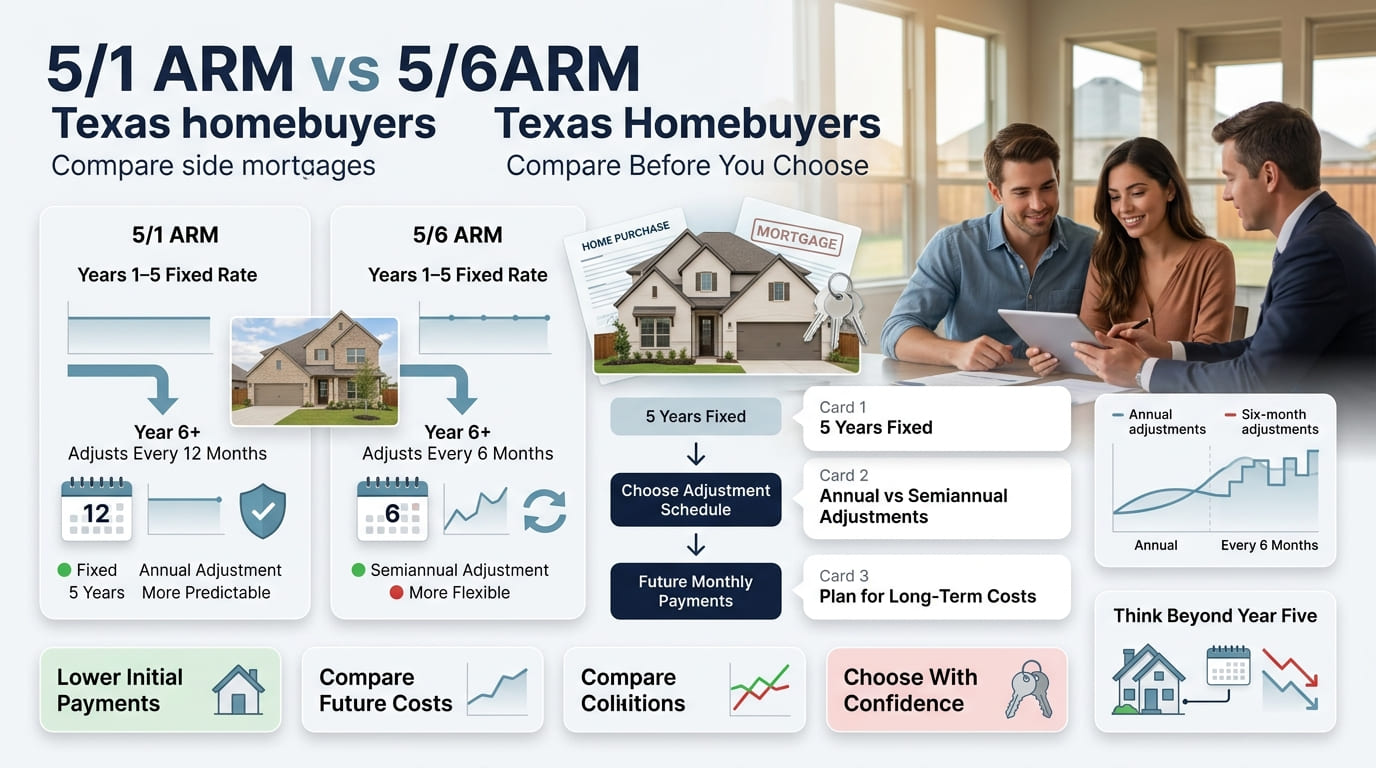
Both adjustable rate mortgages offer a fixed introductory rate followed by periodic adjustments. The primary difference is how frequently the interest rate changes after the fixed period ends. While a 5/1 ARM adjusts once every year after the first five years, a 5/6 ARM adjusts every six months after its initial five year fixed period.
As mortgage rates remain elevated compared with the record lows seen in previous years, many Texas buyers are considering adjustable rate mortgages to reduce initial monthly payments while planning for future refinancing or relocation.
What Is a 5/1 ARM?
A 5/1 ARM provides a fixed interest rate for the first five years of the loan. After the introductory period expires, the interest rate adjusts once every twelve months based on the loan's benchmark index and margin.
For borrowers planning to move or refinance within several years, a 5/1 ARM can provide lower initial payments than many fixed rate mortgages.
What Is a 5/6 ARM?
A 5/6 ARM also offers a fixed interest rate during the first five years. However, once the fixed period ends, the interest rate adjusts every six months instead of annually.
Because rates are reviewed more frequently, monthly payments may change more often depending on market conditions.
5/1 ARM or 5/6 ARM: Key Differences
Key Takeaway
The biggest difference between a 5/1 ARM and a 5/6 ARM is not the initial fixed period but how frequently the interest rate adjusts afterward.
Why Texas Homebuyers Consider Adjustable Rate Mortgages
Texas continues to attract new residents because of its growing economy, expanding job market, and relatively affordable housing compared with many coastal states. Buyers in cities such as Dallas, Houston, Austin, San Antonio, and Fort Worth often choose adjustable rate mortgages to maximize purchasing power.
An ARM may be suitable for buyers who:
- Expect income growth.
- Plan to relocate within five to seven years.
- Intend to refinance before adjustments begin.
- Want lower initial monthly payments.
For borrowers expecting to remain in their home for decades, a fixed rate mortgage may provide greater long term stability.
How Rate Adjustments Affect Monthly Payments
Once the fixed period expires, both loans begin adjusting according to the loan agreement.
Factors influencing future adjustments include:
- Market interest rates
- Index performance
- Loan margin
- Periodic adjustment caps
- Lifetime interest rate caps
Although adjustment caps limit how much rates can increase during each adjustment period and over the life of the loan, borrowers should understand their maximum potential payment before choosing any ARM.
Pro Tip
Request an amortization schedule showing several possible adjustment scenarios. Seeing best case and worst case payment estimates helps you prepare for future changes.
Which Borrowers Benefit Most?
First Time Buyers
Lower introductory payments may help qualified buyers purchase sooner while building financial flexibility.
Young Professionals
Borrowers expecting salary growth over the next several years often use ARMs as part of a long term financial strategy.
Relocating Professionals
Employees anticipating corporate transfers or career moves may benefit if they sell before the adjustment period begins.
Real Estate Investors
Some investors prioritize lower early payments to improve short term cash flow.
Long Term Costs: Looking Beyond the Initial Rate
A lower introductory rate does not always mean lower lifetime borrowing costs.
Before choosing between a 5/1 ARM or 5/6 ARM, compare:
- Total interest paid
- Expected ownership period
- Future refinancing opportunities
- Rate adjustment frequency
- Maximum lifetime interest rate
- Monthly payment affordability
Borrowers who remain in the home beyond the fixed period may ultimately pay more than they would with a traditional fixed rate mortgage if market interest rates rise significantly.
Why Work With Merchants Home Lending?
Every borrower has different financial goals, and selecting the right mortgage should reflect your individual circumstances rather than current headlines.
At Merchants Home Lending, experienced mortgage professionals help Texas homebuyers compare adjustable rate and fixed rate mortgage options, evaluate payment scenarios, and choose financing solutions that align with both short term affordability and long term financial objectives.
Whether purchasing your first home, upgrading to a larger property, or refinancing an existing mortgage, personalized guidance helps you make informed decisions with confidence.
Key Takeaways
- Both the 5/1 ARM and 5/6 ARM provide fixed rates during the first five years.
- A 5/1 ARM adjusts annually after the fixed period, while a 5/6 ARM adjusts every six months.
- Lower introductory payments may improve affordability for qualified borrowers.
- Long term costs depend on future market conditions and how long you keep the loan.
- Comparing payment scenarios before applying helps reduce financial surprises.
Frequently Asked Questions
What is the difference between a 5/1 ARM and a 5/6 ARM?
A 5/1 ARM adjusts once every year after the initial five year fixed period, while a 5/6 ARM adjusts every six months after the first five years.
Is a 5/6 ARM better than a 5/1 ARM?
Neither loan is universally better. The right option depends on your financial goals, expected homeownership period, and comfort with future payment adjustments.
Are adjustable rate mortgages a good choice in Texas?
They can be for borrowers planning to sell or refinance before the adjustment period begins or those expecting higher future income.
Can I refinance before the adjustment period?
Yes. Many borrowers refinance into another mortgage before the first adjustment if market conditions and financial circumstances allow.
Should I choose an ARM or a fixed rate mortgage?
If long term payment stability is your priority, a fixed rate mortgage may be preferable. If you expect shorter ownership or future refinancing, an ARM could provide lower initial payments.
External Resources
For additional mortgage education and adjustable rate loan information, visit:
- Consumer Financial Protection Bureau: https://www.consumerfinance.gov/
- Freddie Mac Homebuyer Resources: https://www.freddiemac.com/
- Federal Housing Finance Agency: https://www.fhfa.gov/
Check VA Rates Now
Take a first step towards your dream home

Free & non binding
No documents required
No impact on credit score
No hidden costs

.svg)

.svg)

