.avif)

.avif)
.svg)
ARM Qualification vs Fixed Rate Mortgage Qualification: What Changes When Rates Move in Alabama?
Choosing between an adjustable rate mortgage (ARM) and a fixed rate mortgage is about more than comparing interest rates. Qualification requirements can also change depending on the loan program, market conditions, and your financial profile. Understanding ARM qualification vs fixed rate mortgage qualification helps Alabama homebuyers choose the financing option that aligns with both their budget and long term goals.
As mortgage rates continue to fluctuate, many borrowers are exploring adjustable rate mortgages because they often offer lower introductory interest rates than fixed rate loans. While this may improve affordability during the early years of homeownership, lenders also evaluate whether borrowers can comfortably afford future payment increases.
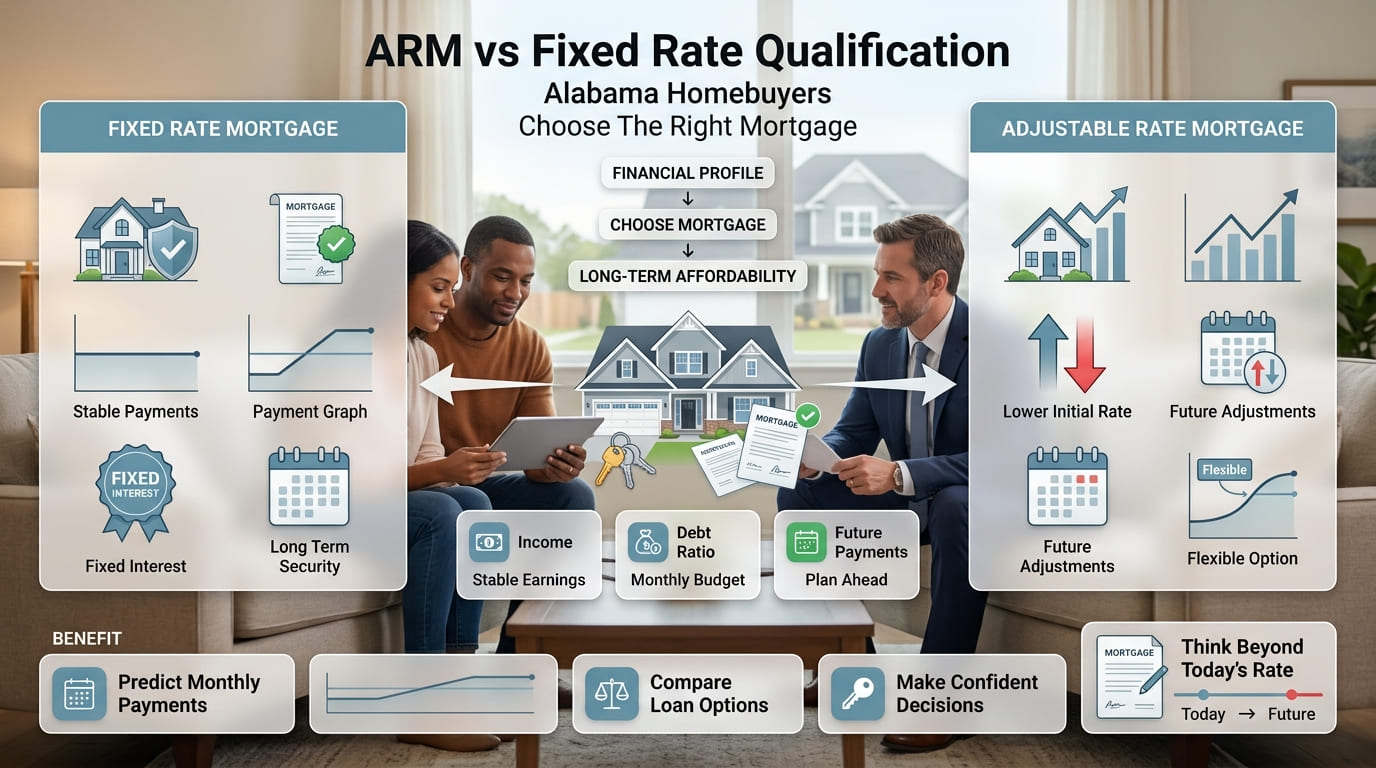
Knowing how lenders qualify applicants for each loan type can help you prepare before applying.
How Does Fixed Rate Mortgage Qualification Work?
A fixed rate mortgage provides the same interest rate throughout the entire loan term. Since monthly principal and interest payments remain consistent, lenders primarily evaluate whether the borrower can comfortably afford those predictable payments.
When reviewing a fixed rate mortgage application, lenders typically consider:
- Credit score
- Debt to income ratio
- Employment history
- Income stability
- Down payment
- Cash reserves
- Property appraisal
Because monthly payments remain stable, qualification is generally based on the fixed payment amount shown in the loan estimate.
How Does ARM Qualification Differ?
An adjustable rate mortgage begins with a fixed introductory rate before adjusting according to market conditions after the initial fixed period ends.
Although the initial payment is often lower, lenders recognize that future payments may increase. For this reason, ARM qualification may involve additional evaluation beyond today's introductory payment.
Lenders commonly review:
- Ability to manage future payment increases
- Current income and expected financial stability
- Debt to income ratio
- Credit profile
- Employment consistency
- Available savings
- Overall financial flexibility
Borrowers with strong financial reserves and stable income often have greater flexibility when qualifying for adjustable rate mortgage programs.
ARM Qualification vs Fixed Rate Mortgage Qualification
Key Takeaway
The primary difference in ARM qualification vs fixed rate mortgage qualification is that lenders evaluate the possibility of future payment adjustments when reviewing adjustable rate mortgage applications.
Why Interest Rates Matter
When market interest rates rise, monthly payments for fixed rate mortgages generally increase immediately for new borrowers because loan pricing reflects current conditions.
Adjustable rate mortgages may continue offering lower introductory rates during certain market environments, allowing some borrowers to qualify for higher loan amounts with lower initial monthly payments.
However, borrowers should understand that these savings may change once the introductory period expires.
Why Alabama Homebuyers Consider ARMs
Alabama continues to attract buyers seeking affordable housing, expanding employment opportunities, and growing communities throughout Birmingham, Huntsville, Mobile, Montgomery, and Auburn.
An adjustable rate mortgage may benefit buyers who:
- Expect income growth
- Plan to relocate within several years
- Intend to refinance before adjustments begin
- Want lower initial monthly payments
Borrowers planning long term homeownership often prioritize the payment stability of fixed rate mortgages instead.
Factors That Influence Qualification
Whether applying for an ARM or fixed rate mortgage, lenders carefully evaluate your overall financial profile.
Important qualification factors include:
Credit Score
Higher credit scores generally improve loan eligibility and may result in more competitive mortgage terms.
Debt to Income Ratio
Lower monthly debt obligations improve borrowing capacity and demonstrate responsible financial management.
Employment Stability
Consistent employment and reliable income help lenders assess repayment ability.
Cash Reserves
Savings remaining after closing provide confidence that borrowers can manage unexpected expenses.
Down Payment
Larger down payments often strengthen loan applications and may improve available financing options.
Which Loan Fits Your Financial Goals?
Neither mortgage is universally better.
A fixed rate mortgage may be ideal if you:
- Plan to stay in your home long term
- Prefer predictable monthly payments
- Want protection from future interest rate increases
An adjustable rate mortgage may be appropriate if you:
- Expect to sell before adjustments begin
- Plan to refinance
- Anticipate higher future income
- Want lower introductory payments
Pro Tip
Before choosing an ARM, ask your lender to provide payment estimates based on several possible future interest rate scenarios. Understanding potential payment changes helps you make a confident borrowing decision.
Why Work with Merchants Home Lending?
Every borrower has unique financial goals, and selecting the right mortgage requires more than comparing interest rates.
Merchants Home Lending works closely with Alabama homebuyers to explain qualification requirements, compare adjustable and fixed rate loan options, and develop financing strategies that support both immediate affordability and long term financial success.
Whether purchasing your first home, upgrading to a larger property, or refinancing an existing mortgage, experienced guidance helps simplify every step of the lending process.
Key Takeaways
- Understanding ARM qualification vs fixed rate mortgage qualification helps borrowers choose the right financing option.
- Fixed rate mortgages provide predictable monthly payments throughout the loan term.
- Adjustable rate mortgages often offer lower introductory payments but may adjust in the future.
- Lenders evaluate future payment affordability when qualifying many ARM borrowers.
- Comparing long term financial goals is just as important as comparing today's interest rates.
Frequently Asked Questions
Is it easier to qualify for an ARM than a fixed rate mortgage?
It depends on your financial profile. Lower introductory payments may improve affordability, but lenders also evaluate your ability to manage future payment adjustments.
Do adjustable rate mortgages have lower qualification requirements?
Not necessarily. Qualification standards vary by lender, loan program, credit history, and financial stability.
Which mortgage is better when interest rates are high?
Some borrowers consider ARMs because of lower introductory rates, while others prefer fixed rate mortgages for long term payment stability.
What credit score is needed for an ARM?
Credit requirements vary by lender, but stronger credit profiles generally improve approval chances and loan terms.
Should Alabama buyers choose an ARM or fixed rate mortgage?
The right choice depends on your expected length of homeownership, income stability, financial goals, and comfort with potential future payment changes.
External Resources
For additional mortgage education and home financing guidance, visit these trusted resources:
- Consumer Financial Protection Bureau: https://www.consumerfinance.gov/
- Freddie Mac Homebuyer Resources: https://www.freddiemac.com/
- Federal Housing Finance Agency: https://www.fhfa.gov/
Check VA Rates Now
Take a first step towards your dream home

Free & non binding
No documents required
No impact on credit score
No hidden costs

.svg)

.svg)

