.avif)

.avif)
.svg)
Negative Amortization or Adjustable Rate Mortgage? Which Option Makes More Sense in Colorado?
Choosing the right mortgage becomes even more important when interest rates are changing. Some Colorado homebuyers compare a negative amortization mortgage with an adjustable rate mortgage (ARM) because both may offer lower initial monthly payments. However, these loan options work very differently and carry different levels of financial risk.
Understanding negative amortization or adjustable rate mortgage options can help you determine which loan better supports your homeownership goals. While adjustable rate mortgages are still a common financing solution, negative amortization loans are far less common and require borrowers to understand how unpaid interest affects their loan balance.
Before choosing either option, it is important to compare payment structures, long term costs, and your expected time in the home.
What Is a Negative Amortization Mortgage?
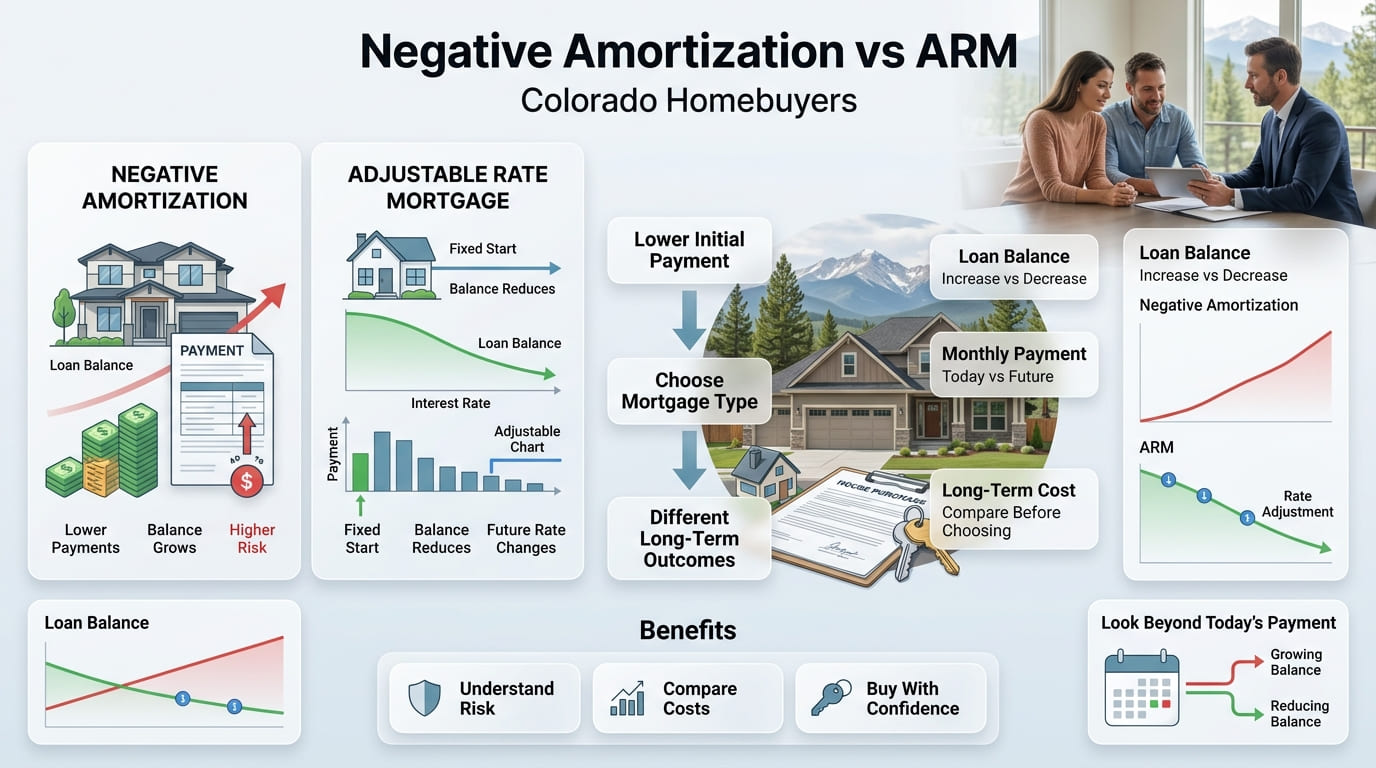
A negative amortization mortgage allows borrowers to make payments that may not fully cover the monthly interest charged on the loan.
Instead of reducing the loan balance, the unpaid interest is added to the principal balance.
Over time, this means:
- Your loan balance can increase.
- Future monthly payments may become larger.
- Interest is charged on a growing balance.
- Equity builds more slowly.
Because of these risks, negative amortization loans are uncommon in today's mortgage market and are generally suitable only for borrowers who fully understand how they work.
What Is an Adjustable Rate Mortgage?
An adjustable rate mortgage begins with a fixed interest rate for an introductory period before adjusting periodically according to market conditions.
Unlike a negative amortization loan, a traditional ARM generally requires fully amortizing monthly payments that reduce both principal and interest throughout the loan term.
Most ARMs include:
- Initial fixed interest period
- Periodic interest rate adjustments
- Annual adjustment caps
- Lifetime interest rate caps
- Fully amortizing monthly payments
Many Colorado buyers choose ARMs when they expect to refinance or sell before future rate adjustments occur.
Negative Amortization or Adjustable Rate Mortgage: Key Differences
Key Takeaway
When comparing a negative amortization or adjustable rate mortgage, the biggest difference is that a traditional ARM reduces your loan balance over time, while negative amortization may temporarily increase the amount you owe.
Why Colorado Buyers Compare These Options
Colorado continues to attract buyers because of its strong economy, outdoor lifestyle, and growing housing markets throughout Denver, Colorado Springs, Fort Collins, Boulder, and Aurora.
Some buyers explore alternative mortgage options to improve affordability when home prices and interest rates rise.
An ARM may benefit borrowers who:
- Expect income growth.
- Plan to move within several years.
- Intend to refinance.
- Want lower introductory payments.
Negative amortization loans generally require much greater financial planning because the outstanding loan balance may increase before repayment begins reducing principal.
Understanding Long Term Costs
Although both mortgage options may provide lower payments initially, long term costs can vary significantly.
With an adjustable rate mortgage:
- Monthly payments may increase after the fixed period.
- Loan balance generally declines with regular payments.
- Total interest depends on future market rates.
With negative amortization:
- Loan balance may increase.
- More interest accumulates over time.
- Larger future payments may be required.
- Building home equity takes longer.
Borrowers should compare total borrowing costs rather than focusing only on today's monthly payment.
Which Borrowers May Benefit?
Adjustable Rate Mortgage
An ARM may be appropriate for borrowers who:
- Plan to own the property for a shorter period.
- Expect future refinancing opportunities.
- Prefer lower introductory payments.
- Understand future rate adjustments.
Negative Amortization Mortgage
Negative amortization loans may only be appropriate for highly qualified borrowers who:
- Have significant financial flexibility.
- Understand increasing loan balances.
- Can manage future payment increases.
- Have a clear long term repayment strategy.
Because of the additional risks, many homebuyers choose fully amortizing mortgage options instead.
Pro Tip
Before selecting any mortgage with variable payments, request multiple payment scenarios from your lender. Reviewing both expected and worst case payment examples helps you understand the long term financial commitment.
Important Questions to Ask Your Lender
Before choosing between a negative amortization loan and an adjustable rate mortgage, ask:
- How will my monthly payment change?
- What is the maximum interest rate cap?
- How much could my payment increase?
- Will my loan balance ever increase?
- What are my refinancing options?
- What happens if market interest rates continue rising?
Having clear answers before closing helps reduce financial surprises later.
Why Work with Merchants Home Lending?
Every borrower has unique financial goals, and selecting the right mortgage requires careful evaluation of affordability, future plans, and risk tolerance.
Merchants Home Lending helps Colorado homebuyers compare mortgage options, understand payment structures, and choose financing solutions that align with both short term affordability and long term financial success.
Whether purchasing your first home, relocating within Colorado, or refinancing an existing mortgage, experienced guidance helps simplify every step of the lending process.
Key Takeaways
- Comparing negative amortization or adjustable rate mortgage options requires understanding how each loan affects your future payments.
- Adjustable rate mortgages generally reduce principal throughout the loan term.
- Negative amortization loans may temporarily increase the amount you owe.
- Lower initial payments do not always result in lower lifetime borrowing costs.
- Reviewing payment scenarios before choosing a mortgage helps you make a more informed financial decision.
Frequently Asked Questions
What is a negative amortization mortgage?
A negative amortization mortgage allows unpaid interest to be added to the loan balance, which can increase the amount owed over time.
Is a negative amortization loan the same as an ARM?
No. An adjustable rate mortgage changes its interest rate after a fixed period, while a negative amortization loan focuses on payment structures that may not fully cover monthly interest.
Which loan carries more risk?
Negative amortization loans generally carry greater financial risk because the loan balance can increase instead of decrease.
Are adjustable rate mortgages common?
Yes. Adjustable rate mortgages remain a common financing option for borrowers planning shorter ownership periods or future refinancing.
Which mortgage makes more sense for Colorado buyers?
For many borrowers, a traditional adjustable rate mortgage offers greater transparency and predictable loan balance reduction. The right choice depends on your financial goals, expected homeownership period, and ability to manage future payment changes.
External Resources
For additional mortgage education and home financing information, visit:
- Consumer Financial Protection Bureau: https://www.consumerfinance.gov/
- Federal Housing Finance Agency: https://www.fhfa.gov/
- Freddie Mac Homebuyer Resources: https://www.freddiemac.com/
Check VA Rates Now
Take a first step towards your dream home

Free & non binding
No documents required
No impact on credit score
No hidden costs

.svg)

.svg)

